48
7LPEHU )UDPH %XLOGLQJV
-RLQHU\ 6HUYLFHV
'DXE 6XSSO\
:DWWOH DQG 'DXE
/LPHFUHWH )ORRULQJ
/LPH 5HQGHULQJ
6XIIRON RI¿FH
&DPEULGJH RI¿FH
(PDLO
VDOHV#HPPHUVRQFULWFKOH\ FR XN
ZZZ HPPHUVRQFULWFKOH\ FR XN
/LPH 3ODVWHULQJ
3DUJHWLQJ
7KDWFKLQJ
&OD\ /XPS %XLOGLQJV
$UFKLWHFWXUDO 'UDZLQJV
&RQWUDFW 0DQDJHPHQW
F
irst and foremost, if you are the proud
new owner of a period property, or
about to become one then many
congratulations!
Not only is your new purchase going to
deliver history, heritage and wonderful
original features to inspire you, you’re also
taking on a property that has already
passed the test of time and will survive for
years to come.
Constructed with traditional techniques
and materials, period properties owe their
success and longevity to their relationship
with the elements. Eponymous builder for
period properties and Listed buildings,
Emmerson Critchley explains: “Delivering
breathability is key – a building where
water becomes trapped is one that will rot
and fall victim to damp. By embracing
water within the building processes, as
many of the traditional techniques and
materials do, the end result is a more
breathable and hardy building that can
cope with the elements and will offer
longevity.”
Emmerson’s own specialist building firm
provides services – including thatching,
pargeting, wattle and daub – that utilise
traditional techniques wherever possible
Preserving the past – building the future
and some of the methods employed
have been in use since Anglo Saxon
times. Emmerson explains: "Much of
what we do relies on having a proper
understanding of the processes
involved and carefully managing the
elements accordingly. Although
these traditional processes can be
more challenging than modern
alternatives I firmly believe that they
offer better longevity for buildings
and a more low impact and
sustainable way forward.”
A good example of this in action is
the use of lime – a traditional building
material. Emmerson affirms: “For lime
render, lime plaster, lime wash,
limecrete flooring – basically any
process involving lime plus many other
traditional techniques, including wattle
and daub – water is used from start to
finish to carefully manage the
carbonation process, which is the
means by which lime naturally hardens.”
Getting the carbonation process
absolutely right is a fine art and a
technical balancing act that relies on
expertise and experience.
Emmerson asserts: “For best results,
it’s crucial to understand the effects
water and humidity have on
workability plus the impact of
differing weather and environmental
conditions.” Managing these different
processes can be a real challenge,
but it's one that Emmerson finds
deeply rewarding. "Although it all
sounds tricky – and it is – I truly
believe that it is worth mastering the
elements through traditional
techniques for the sake of creating
and preserving beautiful buildings
that will endure the test of time.” So
owners of period properties may well
discover a new respect for, and
understanding, of the elements
during the journey of ownership
If the property is a project then it
will be very fruitful and rewarding
(possibly painstaking too at times) to
restore an old place to its former
glory, or to breathe new life into an
old space by making it fit for modern
living. Nevertheless taking on such a
challenge is not only creating a
wonderful house in which to live now,
but also ensures that the property
has purpose for future generations.
Suffolk’s historic streets are lined
with wonderful old buildings –
perhaps a bakery or forge in a
previous life – and while perfectly
accommodating their former working
activities, sometimes careful
consideration needs to be given to
how best to use the space to
sympathetically facilitate all the mod
cons and infrastructure associated
with the modern world. So the owner
of a period property will end up being
pretty accomplished in a residential
form of ergonomics too!
Sympathetically converting period
properties, or adding an extension
that is perfectly in keeping with the
original building, are both everyday
undertakings for Emmerson. He has
excellent working relationships with
local planning departments and
conservation officers, which is
crucial, particularly for Listed
buildings and those in a conservation
area. Each and every project
presents its own challenges.
Emmerson enthuses: “Working with
the space available, whilst delivering
all that we expect from a modern
house but within a period setting,
and ensuring that idiosyncratic
period features are showcased and
conserved is no mean feat but the
end result is always so rewarding.
Literally every project is unique - it’s
a labour of love for the owner but
also for me and my team too. For all
these reasons, I am completely
passionate about what I do.
Emmerson Critchley, an
expert in building and
period properties,
explains his craft
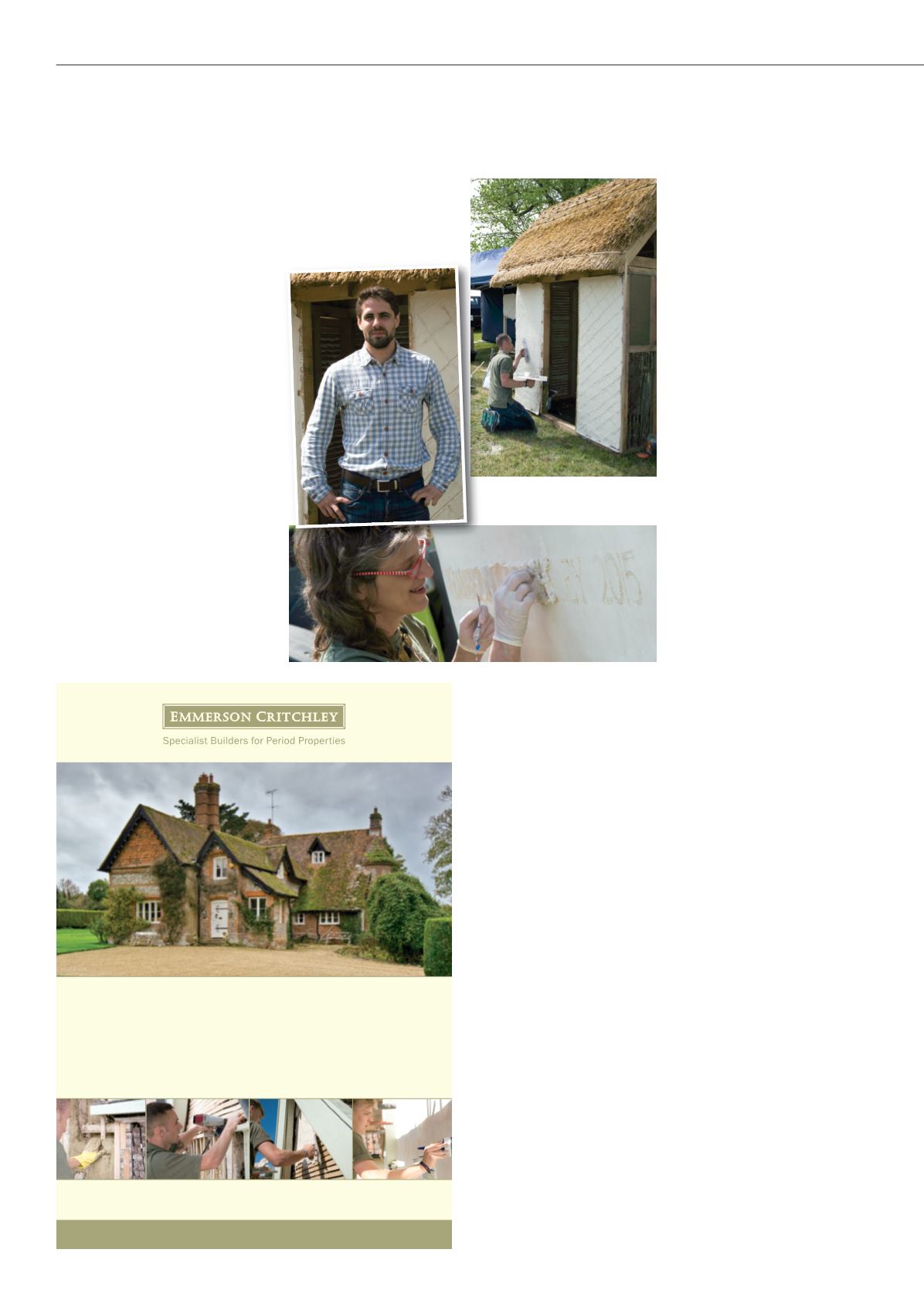
Left; Emmerson Critchley. Above
plastering and, below, pargeting


