12
P
ewter Partnership Surveyors are
period property specialists covering
central London, Essex, Hertfordshire,
Cambridgeshire and Suffolk. In this
article, William Pewter, the Senior
Partner, discusses Xestobium rufovillosum, more
commonly known as deathwatch beetle.
Often found in older, period properties prone to
damp, deathwatch beetle infestation manifests
itself in old oak and other hardwood timbers that
have been affected by damp or fungal decay.
Deathwatch beetle gets its name from the loud
tapping noise it makes during the mating season,
which is usually in April or May. It was often
associated with death, hence its name. During the
silent vigil kept at a close one’s near death, the
rather loud tapping noise could be heard. This
tapping was likened to the ticking of a clock,
tapping away the last moments of a loved one’s
life. Indeed, the Victorians, who were a
superstitious lot, thought that the tapping sound,
when heard, heralded an imminent death. Henry
David Thoreau observed in an article in 1838 that
the sound was similar to that of a heartbeat, which
Edgar Allan Poe’s grim short story, ‘Tell Tale
Heart’, published in 1843, also refers to.
In order to control this type of infestation, it is
important to ensure timbers are completely dry,
which deters the beetle by not providing the
habitat they need. Unfortunately in period
properties, such as structural oak timber framed
buildings, this can be difficult. Some have
vulnerable sole plate areas, which are like the sole
of a shoe, with horizontal timbers laid directly on
earth or low brick courses, known as pinings.
When these were constructed, damp-proof
courses were not in existence as polythene had
not been invented. Therefore they were vulnerable
to moisture absorption, which is the ideal
environment for the deathwatch beetle to live in
and cause their damage.
The original builders used control measures,
such as exposed soft red brickwork with lime
based products, to allow the sole plates to breathe
and dissipate moisture. Consequently the
moisture content of the timber frame was too low
for the deathwatch beetle to easily survive.
Ironically a lot of damage to timber framed
buildings has occurred in the last few decades by
the prevalent use of cementitious renders and
bitumastic paints for example, which are used to
cover up, encase and conceal failing sole plates
and ageing brickwork. Although rendering, tidying
up and painting these areas cosmetically
enhances the building, essentially from a
structural point of view, such dramatically reduces
the lifespan by inhibiting the building’s ability to
‘breathe’.
The lifespan of the beetle can be some twelve
years. Whilst the adult only lives for a few weeks,
it is the larvae that causes significant damage by
burrowing through the timber. In spring, the
emerging adult will mate and the hatched larvae
will then burrow back into the wood, thus renewing
the cycle. It is also thought that the adult does not
need to emerge to mate. The mating process can
take place in cavities within the wood and some
have documented in fact that when female adults
emerge and mate, they will often re-enter old flight
holes and lay eggs deep into the timber.
Because the deathwatch beetle can indeed
mate within the timber work, and hence do not
come into contact with surface applied insecticide,
the life cycle is uninterrupted and the long-term
damage caused can be substantial.
Mere surface spraying of the affected timbers,
kills spiders and clerid beetles, which are the
natural predators of the deathwatch beetle, but
has no effect on the deathwatch larvae and could
be assumed to drive them further into the timbers.
Deep kill paste provides a greater penetration of
the timber as the deep kill paste is spread over the
timber which forms a skin, thus preventing
evaporation of the carrier solvent but enhances
the penetration of the active insecticide.
If dampness is an issue, ensuring that the
property is quickly dried out, by means of heating,
ventilation and remedying any sources of moisture
ingress, is advised. We understand no timber
treatment companies offer long-term guarantees
for deathwatch beetle infestation. Therefore
maintaining the building in as dry a condition as
possible is the primary method of control. Sole
plate replacement also has to be considered as a
building maintenance upgrade, but such can be
very costly, thus thorough investigation of these
areas is essential prior to purchase.
n
For further information contact Pewter
Partnership Surveyors on 01787 460964.
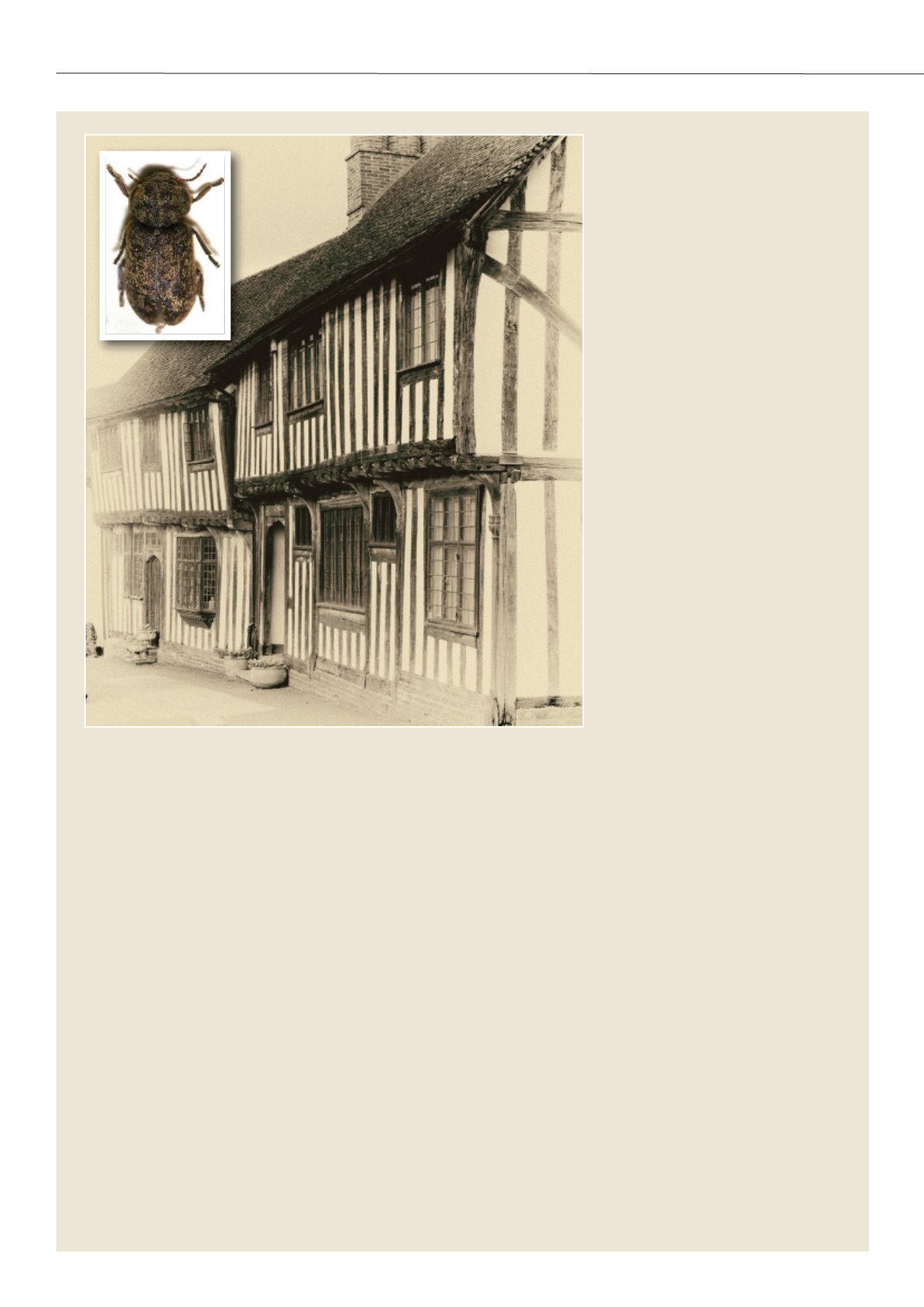
Xestobium rufovillosum, otherwise known as the Deathwatch beetle, and a timbered Suffolk building
Perilous problems with period timber frame buildings
Tapping that says a
pest is in the house


