‘
but to get fired so I grew my hair and
stopped wearing a tie. After a while the
editor called me in and said: ‘Steve I’m
afraid I’m going to have to let you go.’”
It was hardly a setback as Harley had
set his sights on a musical career. Playing
in bars and clubs allowed him to establish
himself and set up the glam-rock band
Cockney Rebel. Hits such as
Sebastian,
Judy Teen, Mr Soft
and
Make Me Smile (
Come Up and See Me)
made the band chart
favourites in the mid 70s and got them on
the BBC’s
Top of the Pops.
“
That was all a bit soul-less, you turned
up during the day to do your recording
and you didn’t really mix with the other
groups.”
“Last Christmas my children told me to
watch one of those old TOTP recordings
because I was going to be on. We tuned in
but the programme passed without
Cockney Rebel - it seemed we were
introduced by Jimmy Savile so the song
and that sequence had been edited out.”
After success and living a hedonistic
lifestyle in the seventies Harley says he
needed a break in the 80s. “I didn’t like the
music scene in that decade,” he says.
He moved to the United States but
didn’t stay for long.
N
ew ventures came in the form of
The Phantom of the Opera
musical
and Harley is candid about his
involvement. First there was the video to
go with the single, directed by Ken Russell
- “an egomaniac who never stopped to
hear what you thought, or wanted to
know about the people he was working
with.”
Harley thought much more of the stage
show’s director Hal Prince despite being
tested by him at an audition. “I had to
perform in front of an audience of people
closely involved with the show and my
co-star Sarah Brightman was also there,
sitting at the back of the theatre. After I
had sung they all got to their feet
applauding but Prince came over to me
and started jabbing his finger into my
chest asking me what the hell I was
playing at. It was a foul-mouthed tirade
and I walked out saying ‘don’t you dare
speak to me like that.’
“I was shaking and not really sure
where I was going. But Prince caught up
with me outside and said he was just
testing me, seeing if I had what it takes to
play the role of the Phantom. Not long
after they gave the part to Michael
Crawford - he had finished Barnum and I
guess he called them up from a beach
somewhere and said he was available.”
Harley doesn’t seem wistful at such
chapters in his life, more glad of the
experience.
Did he ever want to be an actor?
“Well I starred in the Samuel Beckett
play,
Rough For Theatre Parts 1 & II,
at The
Arts Theatre in London. But no, it wasn’t
really a world I wanted to get into.”
He still enjoys touring but can’t
understand musicians who shut
themselves away in hotels and prefer to be
on their phones or tablets rather than
discover the town or city they are visiting.
“Some of us like to book in then go out
and visit a museum or gallery before our
shows.”
He met his wife Dorothy while on tour
and flying from Glasgow to London. She
was a stewardess, he was playing the tired
and slightly bored rock star. “It was love
at first sight - or almost first sight. She
came up to our group and said someone
on the plane wanted my autograph.
Initially another one of the band signed
but then I looked up and realised I should
tell her who I was and that we were just
playing a game.”
They married in 1981 and have a son
and daughter, Kerr and Greta. Home is not
far from Clare and they love the
countryside and its wildlife. Harley tells
me they spend a fortune each year on bird
seed. During our conversation in the beer
garden of Long Melford’s Swan Inn, he is
distracted by the plight of an injured baby
blackbird. He puts down some milk in a
saucer hoping it might take some but the
bird hops away. “ I’m afraid that one’s not
going to survive.”
Harley’s base on the Suffolk/Essex
border means he is not far from Cockfield
where his family, the Nices and the Fayers,
have roots.
“I met Bill Wyman, who has a house in
the area, and he said I must read an old
book about the village. Apparently it was
out of print and I didn’t think anything
more about it then a few day’s later he
found and posted me a copy. That says
something about the guy. Nice man.”
Horse racing has become a hobby for
Harley and he likes going to Newmarket.
He once owned a horse with the late Mel
Smith and he likes a bet or two, though he
says he has friends who really study the
form. “You could call them gamblers but
they don’t really ‘gamble’ they look closely
at the form and exchange rates day and
night. They are professionals - I’m an
amateur.”
And last but by no means least what
about the song most people associate with
Harley?
Make Me Smile (Come Up And See
Me)
reached number one in the UK charts
during 1974 and spent nine weeks in the
top 50. It had sold around 1.5 million
copies worldwide as of February last year
and more than 120 cover versions of the
song have been recorded by artists as
diverse as Duran Duran, Erasure and The
Wedding Present.
Harley wrote it about the break up of
the first version of Cockney Rebel,
weaving some typically forthright lyrics
into a song decorated by a flamenco
guitar solo and punctuated by one of the
most catchy choruses in pop.
“Of course, we still play it - audiences
want to hear your old hits as well as any
new material. While I’m up there playing
I sometimes think to myself ‘okay you
may not know about some of our songs
but you are sure going to know this one,’
and the opening bars always do the
trick.”
“I’ve been known to get my camera out
and video festival audiences doing the
singalong . . . it never fails to move me.”
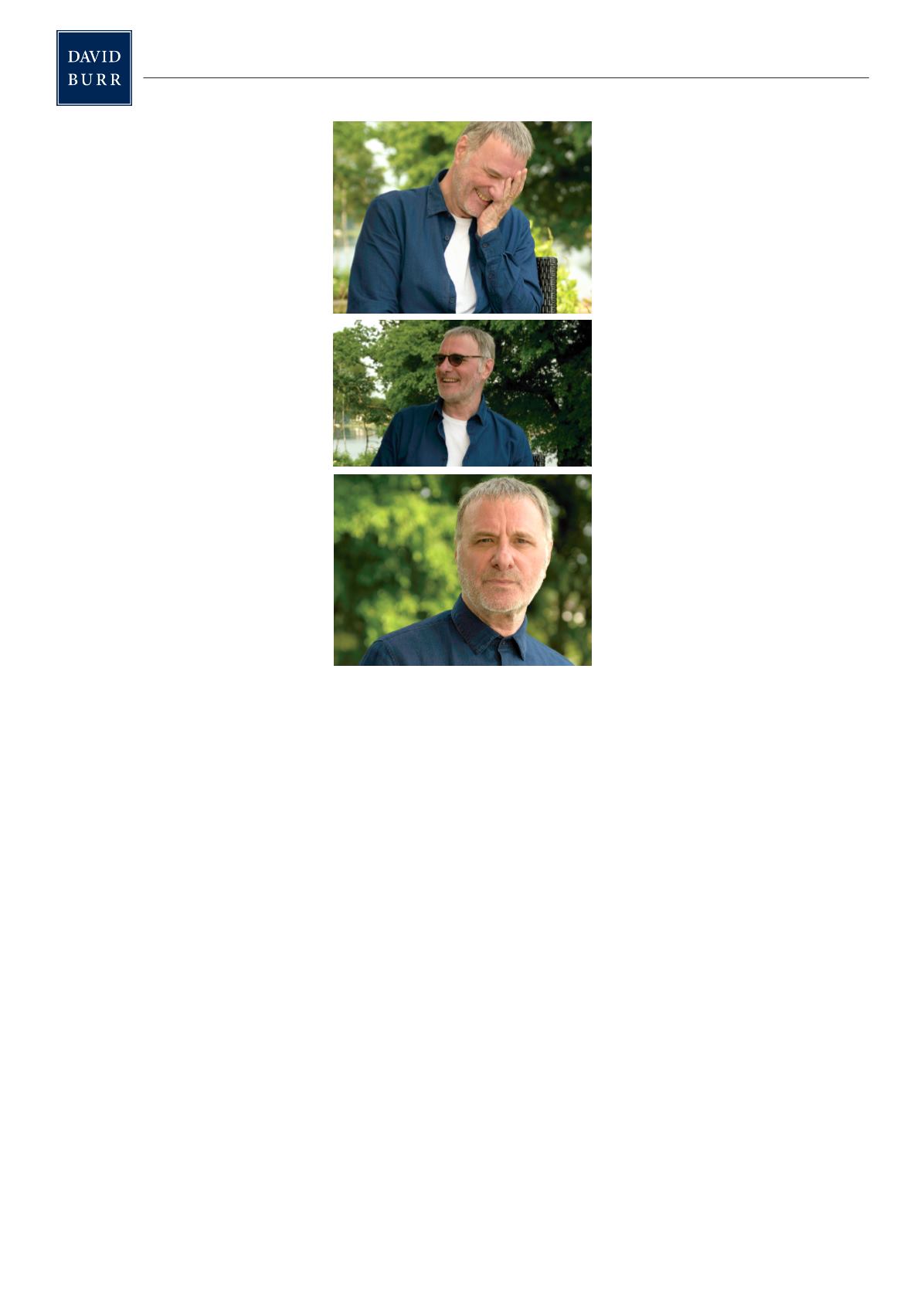
Steve Harley summer 2016 images: Mike Callow
12


