21
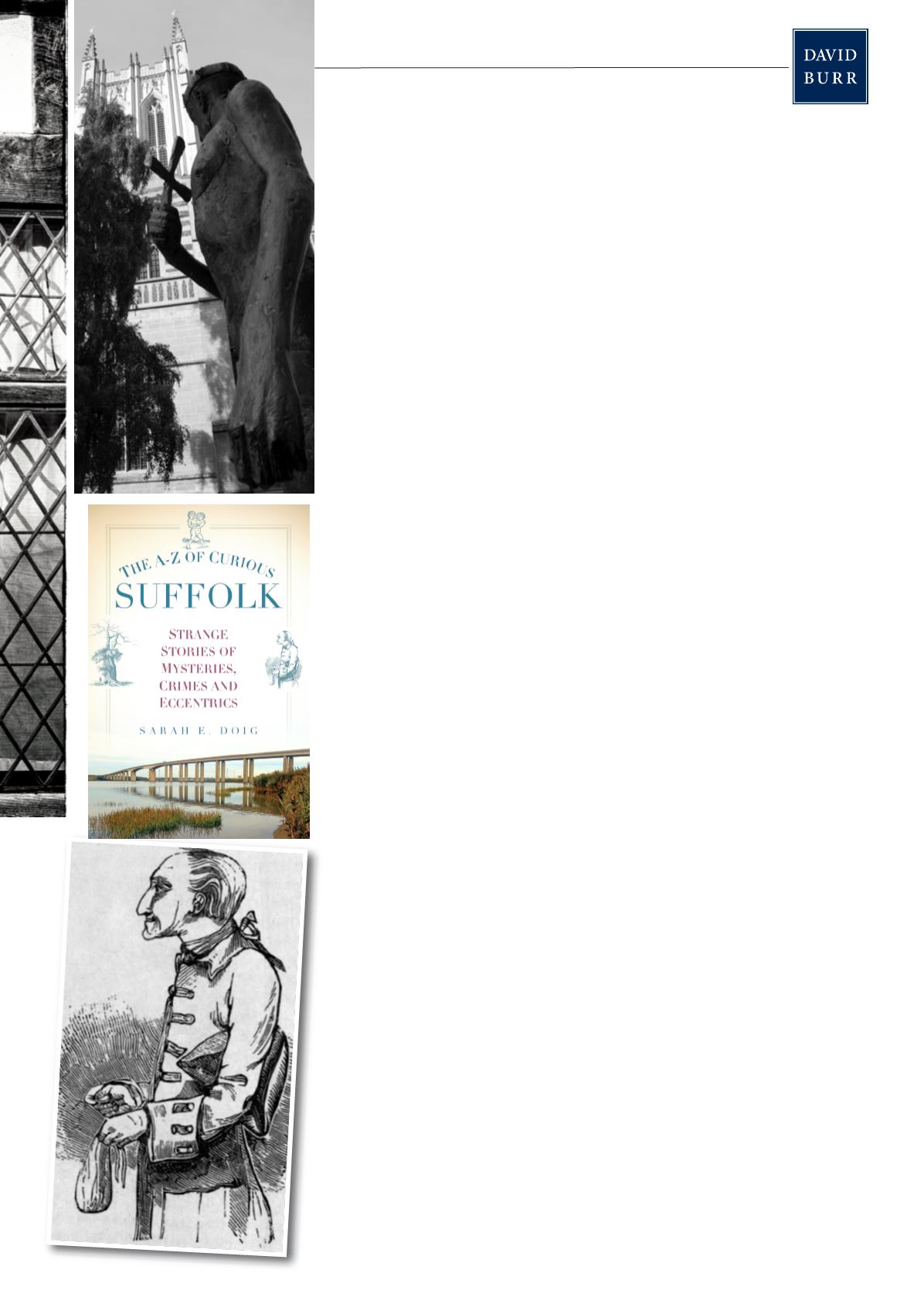
John Elwes of Stoke-by-Clare is said to
have been the “role model” for one of the
novelist’s most famous characters;
Ebenezer Scrooge in
A Christmas Carol
.
When the unmarried John Elwes died in
1789 he left around £500,000 to his two
illegitimate sons, who he reportedly loved
but would not educate, believing that
“putting things into people’s heads is the
sure way to take money out of their
pockets”. Elwes had, by all accounts,
inherited his miserliness (as well as his
fortune) from his immediate family, not
least from his uncle. John Elwes was
reported to have gone to bed when
darkness fell to save on candles, and ate
very little apart from mouldy meat and
stale bread. The other miser was William
Jennens of Acton Hall near Long Melford.
When he died in 1798 he was described as
the richest commoner in England, his
property being worth more than £2
million. A protracted legal wrangle then
ensued between various parties who
believed they were heirs to the fortune.
This Court of Chancery case reportedly
continued until 1915 when the funds
available from the estate simply ran out. It
is believed this famous case gave Charles
Dickens the idea for the central plot of his
novel,
Bleak House
, which features a long-
running legal dispute,
Jarndyce vs Jarndyce.
I also like the rather comical story
connected to the building of the
Millennium tower at St Edmundsbury
Cathedral in Bury. The completion and
enlargement of the cathedral was the
inspiration of Stephen Dykes Bower who
was the cathedral’s architect between 1943
and 1988. He drew up the original design
for the completed cathedral which
included a spectacular Gothic tower.
Although he was able to see much of his
dream become reality, there was simply
not enough money to complete the tower.
When he died in 1994 he left £2 million
towards the tower project which turned
into what became the ambitious
Millennium Project. £4 million was raised
from a public appeal to which the
Millennium Commission added £6
million. Prince Charles, HRH The Prince
of Wales, was the project’s patron and laid
the first brick in July 2001. In an earlier
comment about the scheme he called the
new tower a “spiritual beacon of the
future”. Unfortunately, the
East Anglian
Daily Times
misprinted the quote, leading
to a comment in the national press about
pigs flying (they had printed it as
“spiritual bacon”)!
What has surprised you about Suffolk?
The sheer diversity of it. I have uncovered
wonderful tales of people from humble
origins who have achieved extraordinary
things like Robert Bloomfield, the
“ploughman poet” from Honington. He
rubs shoulders in my book with the likes
of members of the famous Cobbold family.
The county also has such a wide variety of
landscapes; from the rolling hills
surrounding Newmarket to the rather
eerie, desolate coastline at places such as
Orford and Shingle Street. I have tried to
draw on stories from all parts of Suffolk.
We seem to be a county big on ghosts…
To be honest, I think every county has its
fair share of ghost stories. Any self-
respecting town will have a myriad of
hauntings. I don’t believe in ghosts, but I
find the tales fascinating. One of the more
bizarre (which I have included in the
book) is the so-called “Rougham Mirage”.
It is not, as is usual, a person, but rather a
whole house which seems to appear and
disappear again in front of people’s eyes.
On a number of occasions between 1860
and 2007, a large red-brick house with
gardens has been seen on a stretch of road
between Rougham Green and Bradfield St
George. There has been no house on this
site since the early 1800s, and no
photograph is known to exist of the
property. Yet witnesses to the ghost house
have given spookily similar descriptions
of the building which is simply not there
one moment and then there the next.
Any plans for another book?
Yes! I have a whole notebook full of ideas
for local history books and articles as well
as outline plans for a trilogy of novels
based in the late Victorian and Edwardian
eras. Sadly, though, there isn’t much
money in it and so I have to juggle the
time I spend writing around activities
which bring in better money; I undertake
family and house history research as well
as play music professionally. However, I
will undoubtedly write other books.
n
The A-Z of Curious Suffolk
is
published by the History Press and out
now, priced £12.99.


