Recording rarities
The difficulty of accurately identifying fungi
means that there are relatively few people
actively recording finds. This means that if one is
interested and spends some time on the subject, it
isn’t long before one stumbles across rarities,
which may in fact simply be under-recorded.
Lackford Lakes (the SWT reserve near Bury) may
seem an unlikely place to find interesting fungi
but in just a ten minute walk I found the rather
small winter stalkball which resembles a rabbit
dropping on a stalk - and it has only been recorded
three times in Suffolk since 1860! The same year,
whilst out hunting fungi with a friend, what I
thought was a very small Jews’ ear fungus, turned
out to be a Schizophyllum ampla growing on a
native black poplar twig, only recorded twice ever
in Suffolk and considered Near Threatened on the
Red Data Book List. And on the same day we
found the diminutive moss oysterling in our lawn,
similarly barely recorded.
So there is huge scope for naturalists to take up the
challenge and get to grips with fungi – and start
finding and plotting these hidden fungi gems on
the Suffolk map. You may need to go on some
good courses, invest in some good books and
definitely have some patience - but the rewards
are well worth the effort.
Suffolk Wildlife Trust nature reserves for
fungi through the year
BradfieldWoods
National Nature Reserve is great
to visit as early as the end of August in some years
to notch up a good list of species in the various
habitats. In the woodland shade, often associated
with a particular host tree, and camouflaged
amongst the leaves one can find an assortment of
blue-green, common, hazel, rufous and ugly
milkcaps (Lactarius species) and the brightly
coloured and fragile brittlegills (Russula species).
The fallen and standing dead wood supports tiny
species and some larger Dryads saddle (Polyporus
squamosus) and birch polypore (Piptoporus
betulinus). And heaps of wood-shavings are
always a good place to hunt out species such as
fawn shield cap (Pluteus cervinus).
GrotonWood
is another excellent SuffolkWildlife
Trust woodland reserve to visit in the autumn. On
an October visit you might sniff out the camphor-
scented and coconut-scented milkcaps or
the crab-smelling Russulas; witness the
huge troops of various funnelcaps or shaggy
parasols marching across the woodland
floor; and be dazzled by the amethyst
deceiver, glistening inkcaps and hundreds
of fairies bonnets.
A later November visit might yield brown
birch boletes and the elegant goblet
mushroom and two-toned wood tuft. And
well into winter you can still find velvet shank on
dead elm or elder and sometimes wood blewitts in
piles of rotting leaf litter.
Meadow reserves in spring/summer may not
seem the most obvious place to look for fungi but
one species, St George’s mushroom is so-called
because it really does fruit on or around St
George’s Day on 23rdApril and its striking,
chunky off-white flesh and gills are difficult to
mistake for anything else. In the autumn, waxcaps
can be discovered amongst the shorter swards.
Heathland sites can throw up a variety of species.
Expect to see fly agaric, ceps, bay boletes,
parasols, brown rollrim, ugly milkcaps, collared
mosscap and the orange mosscap, the deceiver,
and various types of puffballs.
G
eoffrey Kibby, the country’s leading
field mycologist once told me that
eating a mushroom or toadstool is
like eating an apple from a tree – they are
effectively the fruiting bodies of a much
larger ‘underground tree’ and so
harvesting and eating the occasional
toadstool does not do the fungi ‘rootstock’
any harm. However, there are several
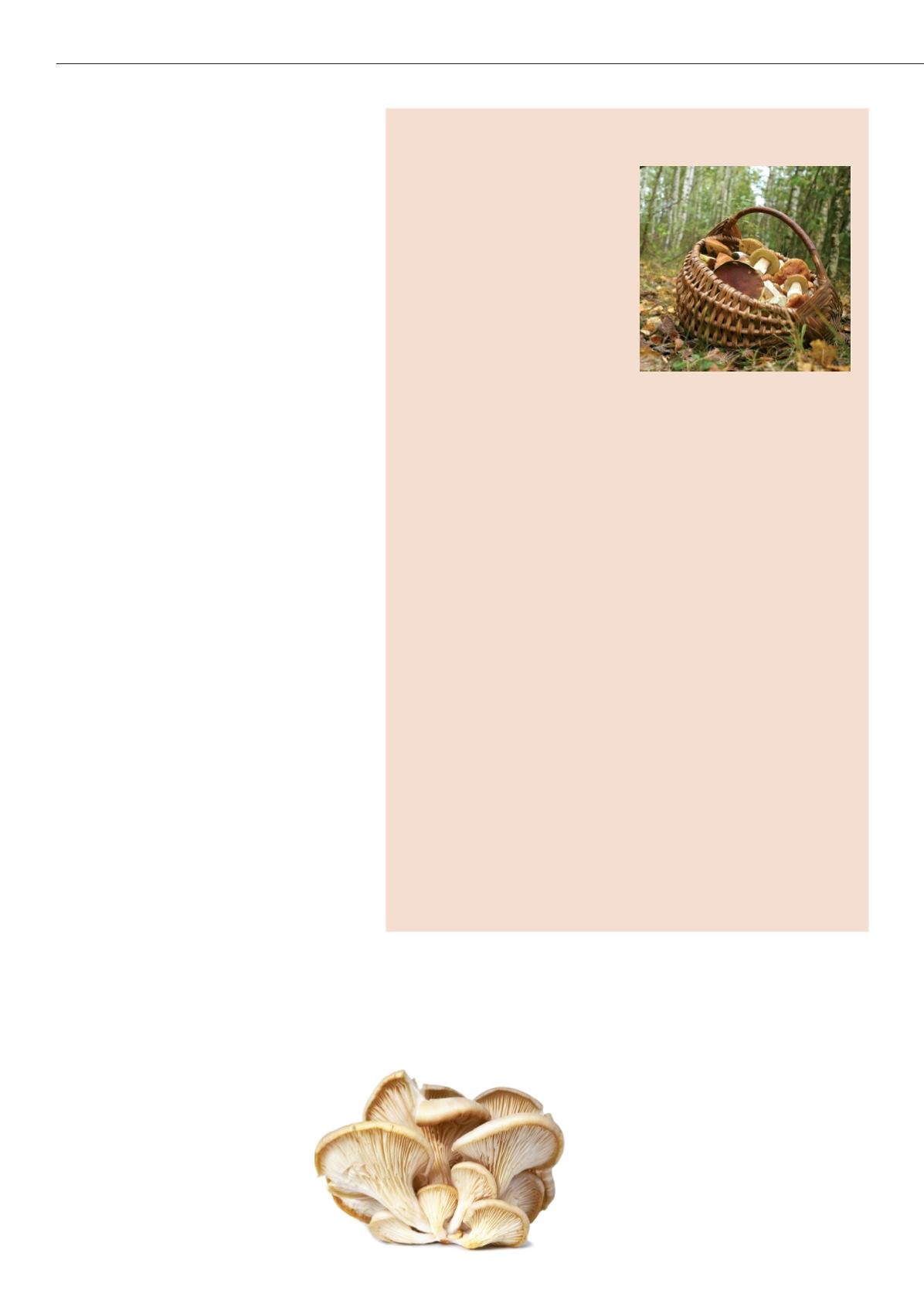
very good reasons not to eat fungi on a
regular basis, or to pick basketfuls of fungi
that you take home and then leave rotting
on the draining board because you bottle
out of eating them ... because ultimately
you’re not 100% sure of your identification
skills.
Firstly, there’s self-preservation. The more
I know about fungi - and I have to admit
that is relatively little when one realises
there are nearly 15,000 species in the UK
and for most of them microscope
examination of spore prints is essential to
be absolutely sure of accurate
identification - the less I want to eat them.
I don’t want to find that I join the list of
individuals who like to tell you how they
eat wild mushrooms, only to find that I
accidentally, poison myself and my family!
Secondly, there’s the conservation of other
creatures which depend on fungi. Unless
you pick a penny bun or a parasol
mushroom at the perfect moment, you will
find that other insects have got there first,
laid their eggs which have hatched and are
enjoying a long-awaited for meal, perhaps
the only meal on which they feed in their
entire life cycle. Thus, gathering up an
entire ‘crop’ of woodland blewits or shaggy
parasols may seem tempting but will
inevitably deprive wild creatures of their
food, perhaps their only food.
So, to my mind, photographing fungi
without adversely disturbing the
surrounding soil or habitat (where there
may be more fruiting bodies emerging) is
fine and even taking one or two specimens
home to identify and record responsibly is
fine too. But, if you pick lots of one
species, remember that you will be
depriving the grubs of small beetles or
small flies of an essential meal and
depriving the next visitor or passer-by the
joy of seeing them in their natural setting.
And actually a good, fully mature flat
specimen of the cultivated field mushroom
fried in plenty of butter is pretty hard to
beat!
Field Studies Council courses on fungi at
Flatford Mill are an excellent way of getting
started with some expert guidance and
there are numerous books on fungi and a
lot are quite misleading. I have found the
most user-friendly books to include the
following:
n
Mushrooms and other fungi of Great
Britain & Europe by Roger Phillips – very
user-friendly key for beginners
n
Collins Field Guide: Mushrooms &
Toadstools of Britain & Europe, R
Courtecuisse & B Duhem - 1750 illustrated
species
n
Dorling Kindersley Eyewitness
Handbook: Mushrooms by Thomas
Laessoe – a really good beginner’s book
with 500 species well annotated
To eat or not to eat?
26


