24
Fungi hunting
Can you tell a puffball from a funnel cap? It helps to know since
some mushrooms are highly poisonous, as Juliet Hawkins explains
W
hilst
theoretically
you can find
mushrooms
and toadstools
– known collectively as fungi - at
any time of the year, I start to dust
off the wicker basket and the other
foraging paraphernalia (camera,
penknife, brown paper bags), get
out my fungi books and start
sniffing the air in the early
autumn after some damp, warm
weather – any time from
September onwards. Fungi-
hunting is a great hobby for early
winter - and much of the
identification can be done inside,
warm by the fire.
Beguiling names
There are nearly 15,000 species of
fungi on the Fungal Records
Database for Britain and Ireland,
and new ones are blowing in on
the breeze, or coming in on
shipments of timber or nursery
trees (such as Chalara the fungi
that causes ash dieback). Rather
like bee orchids that flower for
years in the same place and then
pop up somewhere completely
different, many species of fungi
only appear once in a lifetime in
the same place. Add to that the
short seasonal window when the
fungi may or may not fruit and
you pretty soon realise, it’s not
easy to become an expert in either
the ecology of individual species
or their identification. Very early
on in pursuing this occasionally
exasperating seasonal hobby, I
realised that some mycologists
take a whole lifetime just
becoming an expert on one family
such as the ‘Brittlegills’ (Russulas)
or perhaps the ‘Milkcaps’
(Lactarius) and don’t even attempt
to identify ‘the little brown jobs’.
But there are huge and varied
families of parasols, funnels,
deceivers, puffballs, earthstars,
bonnets, poisonpies, webcaps,
saddles, corals, oysters, knights
and cavaliers to tempt you out on
a damp autumn day.
And how beguiling and appealing
they and their common names are
– the velvet shank hedgehog
fungus, jelly babies, lawyer’s wig,
and russet tough-shank conjure
up exciting images before you
even venture out. Whilst many
fungi have well-known common
names and there is a now a new
23-page long list of recommended
English names (which often gives
you clues as to the look or smell of
the fungi), the Latin nomenclature
is constantly changing and books
can be very confusing in this
aspect.
The garden lawn and
veggie garden
The garden lawn is always a good
place to start in September or
October. We nearly always have
the exotic-coloured parrot wax cap
and snowy wax cap, but last year
the rather grey-coloured slimy
wax cap appeared while under the
beech tree skulked the slimy milk
cap, and beware, occasionally the
death cap cunningly disguised as
an edible mushroom at button
stage. The lawn funnel cap (also
deadly poisonous) is often
scattered in rings and troops
across the lawn and now I don’t
agonise about dividing it between
Clitocybe rivulosa or C dealbeata
as the experts have announced
that it is one and the same!
Sometimes sulphur tuft and honey
fungus appear where trees once
stood. And elsewhere amongst
the slightly longer grass are the
One of the up-sides of a damp British summer is the fascinating
display of mushrooms and toadstools that usually follows in the
autumn and winter. Juliet Hawkins, Suffolk Wildlife Trust’s farmland
conservation adviser, discusses her seasonal hobby and provides
some tips on when and where to look for fungi . . .
As long as you are
careful what you
pick, some
mushrooms can
be tasty additions
to winter meals
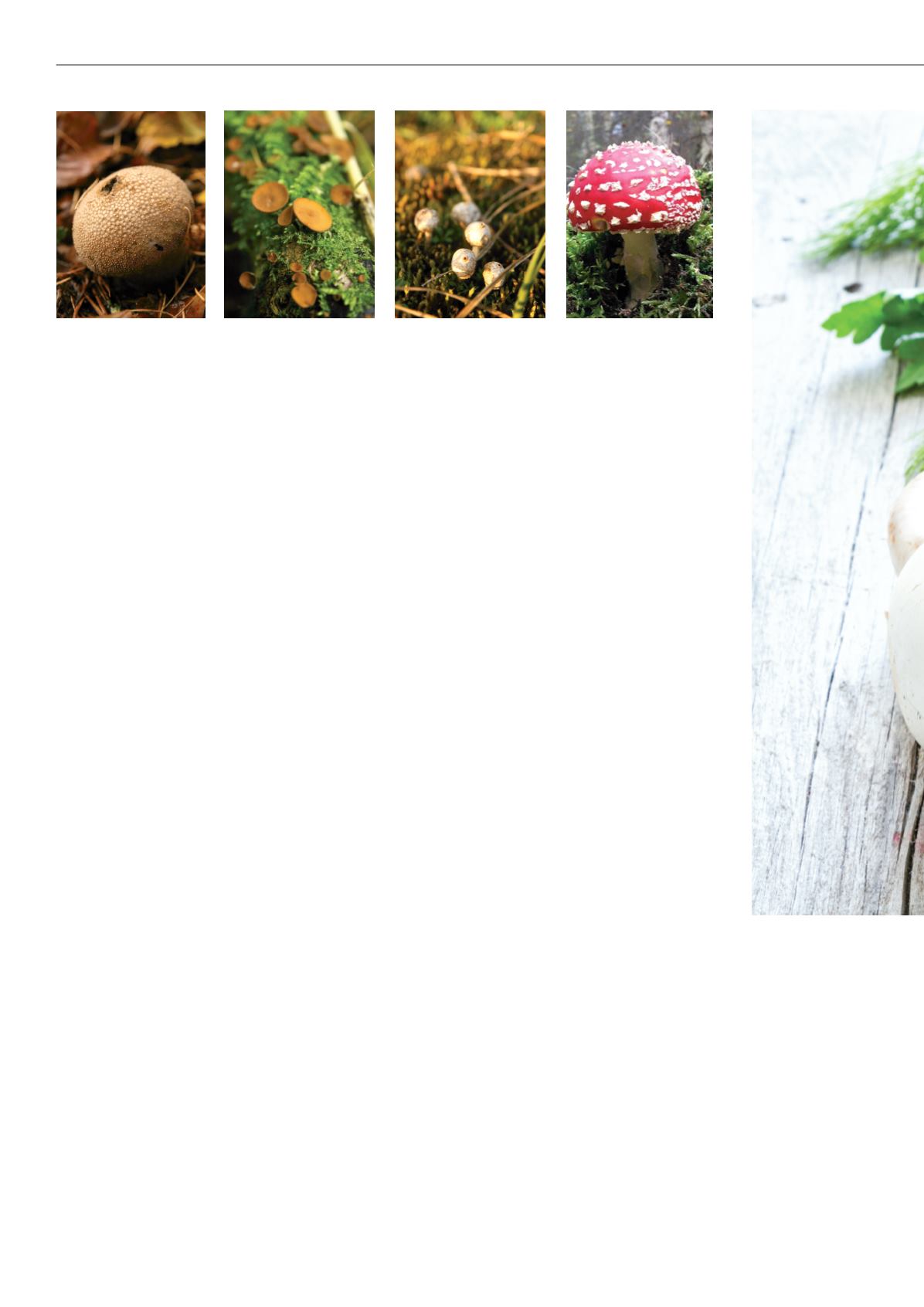
Left to right: Common puffball, Rustroemia firma, Tulostoma brumale and the eyecatching Fungifly agaric


