68
T
here are two kinds of
landmark that stand vigil
over our county landscape
– church towers and water
towers. However, while
many church towers are centuries old,
their water equivalents date from the
20th century. Because the landscape is
either flat or gently undulating, they are
visible for miles in all directions around
them. From a distance the distinctive
geometric shape is clearly silhouetted
high against the sky. On closer
inspection, it becomes clear that the
water tank is either octagonal, hexagonal
or cylindrical, all being supported on
columns. The columns may be slender or
sturdy for they are calculated to support
the weight of the tank plus water
whatever the weather and wind
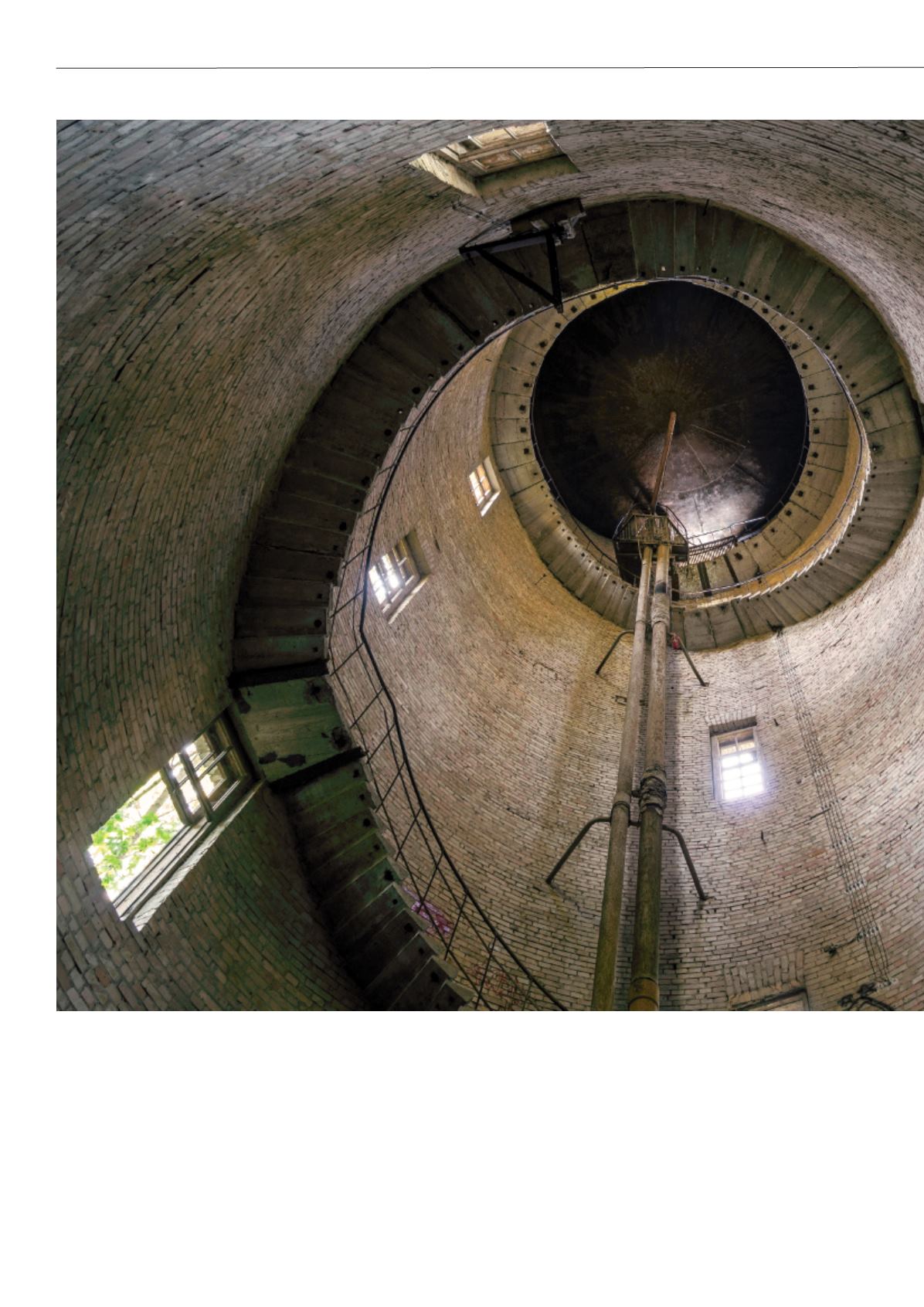
strength. Access from the ground may be
through a central core support,
sometimes with windows in it to provide
some light for men climbing the stairs. A
ladder against the central pillar provides
access to the top level. Access to the tank
is necessary because the tank needs to be
emptied and cleaned approximately
every five years.
Our flat landscape is the reason
towers have been built to store water.
They are a feature of the low-lying
counties of Norfolk, Suffolk, Essex,
Bedfordshire and Lincolnshire. Counties
situated in hill country have reservoirs
on high ground from which the water
Going
with the
flow
They are a feature of
our East Anglian
lamdscapes but how
are water towers built,
and why do we need
them? Christine E
Jackson explains


