69
flows naturally down to the towns and
villages on lower ground. The towers
were costly to construct, consequently
the design capacity rarely exceeded the
equivalent of one day’s supply of water
for local houses – usually between
20,000 and 50,000 gallons. Some are
much larger when supplying towns
such as Woodbridge that has a 150,000
gallon tank. (The tanks were calculated
to hold a certain number of gallons. To
convert to litres multiply by 4.546).
In the 1930s water was being piped to
individual properties for the first time.
Before then, wells and village pumps
were the source of everyone’s water
supply. The piped water necessitated
large storage of water in reservoirs, but
for properties on higher ground than the
reservoir, water towers were needed to
hold the water at a level where it could
flow down to them. Pressure pumps
lifted the water from a reservoir into the
tank on the top of a tower built of bricks,
so if you see a brick water tower it
probably pre-dates the Second World
War. Post 1945 the towers were built of
concrete.
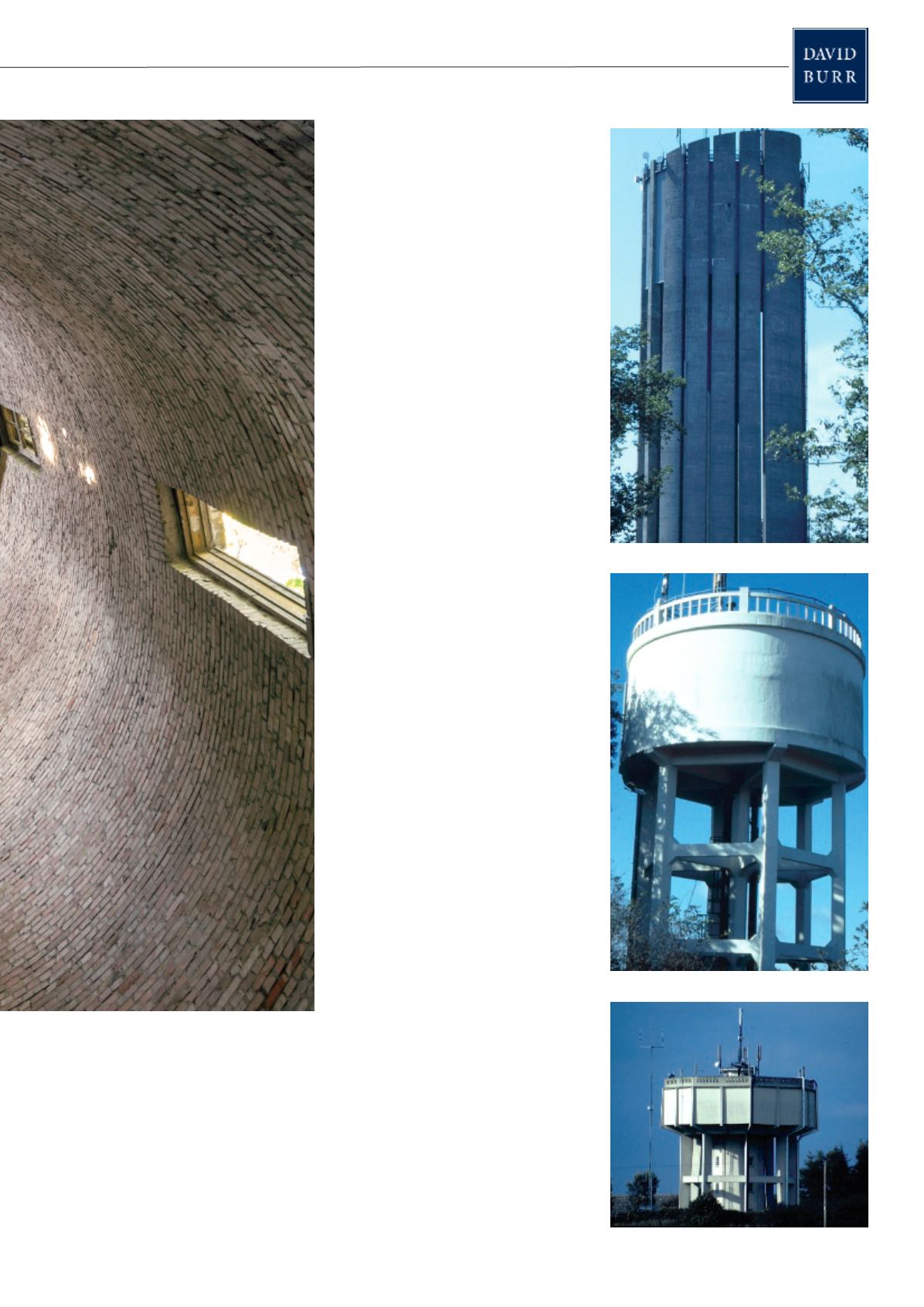
In Suffolk there are approximately 50
water towers, with different architectural
and structural designs. They are well
designed by engineers but because they
were constructed in brutal concrete, they
cannot be regarded as objects of beauty,
except when seen from a distance. Then,
their pleasing geometrical shapes add to
the interest of the skyline.
They are always worth a second look,
because they are rarely duplicated, each
being of a unique design and differing in
size according to the capacity of water
storage required. Some attempts to soften
the stark concrete have been made by
painting them in different colours.
Why does the county have water
stored in towers? It is to guarantee water
pressure. The gallons held on high are
used when demand increases on the
storage below, at teatime or during
advertisement breaks in popular
television programmes.
This is re-filled from a ground level
reservoir via a pumping station, e.g. at
Stone Lodge a concrete reservoir
underneath a grassy mound contains 40
million gallons of water. This is used to
pump into the water tower to supply
homes on higher ground while the
reservoir water supplies water direct to
houses on lower ground.
A tower’s height measurement is
given as TWL (top water level) and BWL
(bottom water level). Usually the distance
between the two is approximately 10 feet.
The overall height varies between 100
feet and 200 feet. Stowmarket, Eye, and
Saxmunham towers, all pre-1948
buildings are over 200 feet, most built
post 1958 are also over 200 feet. The
highest, nearly 300 feet, e.g. Middlewood
Green at 285 feet with 250,000 gallons,
catered for the greatest capacities.
In East Suffolk a number of similar
‘
The tower at Bradfield St Clare
A more conventional water tower at Gazeley
Rushmere near Ipswich, a more elegant water tower
The inside of
a water tower


